Hook
What if the treasure you’re chasing has been quietly waiting for you all along?
Book Overview
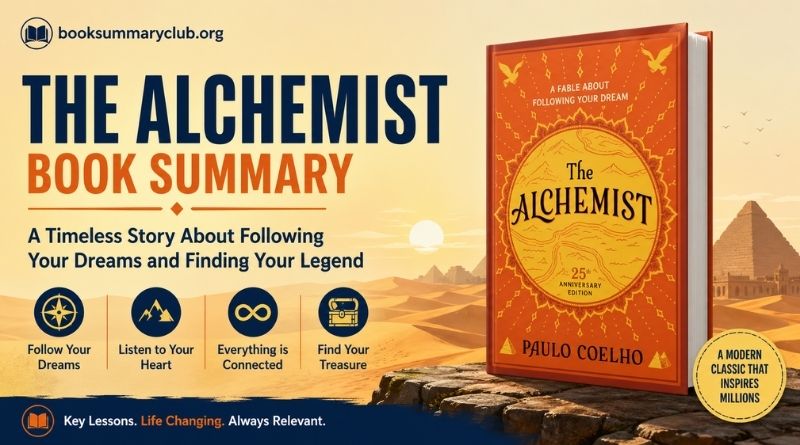
The Alchemist by Paulo Coelho is a short yet deeply philosophical novel about a young shepherd named Santiago who dreams of discovering a hidden treasure. First published in 1988, this book has since become a global phenomenon, inspiring millions with its simple storytelling and profound life lessons.
At its core, this the alchemist book summary explores destiny, courage, and the idea that the universe conspires to help you when you truly commit to your dreams.
Key Themes
Here are the most powerful ideas that stand out in this book summary:
- Follow Your Personal Legend
Everyone has a purpose in life, and happiness comes from pursuing it wholeheartedly. - Listen to Your Heart
Intuition often knows the truth before logic catches up. - The Journey Matters More Than the Destination
Growth happens through experiences, not just outcomes. - Fear Is the Biggest Obstacle
Most people abandon their dreams because they fear failure or loss. - Everything Is Connected
Coelho introduces the idea of a universal language that binds all things together.
Chapter / Section Highlights
Let me walk you through the story the way it unfolds—because this isn’t just a plot, it’s a journey you feel.
A Dream That Won’t Let Go
We meet Santiago, a shepherd in Spain who lives a simple life. But there’s something restless about him. He keeps dreaming of a treasure hidden near the Egyptian pyramids. Most people would ignore such a dream—but Santiago doesn’t.
That’s the first thing that hits you: this story respects curiosity. It nudges you to take your dreams seriously, even when they sound irrational.
The King Who Changes Everything
Santiago meets Melchizedek, the mysterious King of Salem, who introduces the idea of a Personal Legend. According to him, everyone knows their purpose when they’re young—but most people forget it over time.
This moment feels like a quiet wake-up call. It’s not dramatic, but it lingers. How many dreams have we quietly shelved?
Lessons Through Loss
Santiago sells his sheep and heads to Africa, only to be robbed almost immediately. It’s a tough moment. You can feel his doubt creeping in.
But here’s what makes the book powerful: it doesn’t pretend the journey is easy. Instead, it shows how setbacks shape resilience. Santiago chooses to keep going, working at a crystal shop to rebuild his money—and his confidence.
The Desert and the Englishman
As Santiago travels across the desert, he meets an Englishman obsessed with alchemy. Through him, we’re introduced to deeper philosophical ideas—the transformation of matter, the search for meaning, and the concept of a “Soul of the World.”
This section blends spirituality with curiosity. It’s less about answers and more about learning how to ask better questions.
Love Without Chains
Santiago meets Fatima at an oasis, and their connection feels genuine and grounding. But here’s the twist: she doesn’t ask him to stay.
Instead, she encourages him to continue his journey.
This moment stands out because it challenges a common narrative—true love doesn’t hold you back; it supports your growth.
Becoming the Alchemist
Santiago finally meets the Alchemist, a wise figure who pushes him to trust himself and understand the language of the world. One of the most unforgettable moments is when Santiago learns to “become the wind.”
It sounds mystical—and it is—but symbolically, it’s about self-belief. It’s about realizing that limits are often self-imposed.
The Twist Ending
After reaching the pyramids and facing yet another setback, Santiago discovers that the treasure was actually buried back where his journey began.
And somehow, it doesn’t feel disappointing.
It feels right.
Because by then, you understand: the treasure was never just gold—it was the person Santiago became along the way.
Memorable Quotes
Here are a few lines that stick with you long after the book ends:
“And, when you want something, all the universe conspires in helping you to achieve it.”
This is probably the most quoted line from the book—and for good reason. It captures the optimism that fuels the entire story. It’s hopeful without being naive.
“Tell your heart that the fear of suffering is worse than the suffering itself.”
This one hits differently. It challenges you to rethink fear—not as protection, but as a barrier.
“There is only one thing that makes a dream impossible to achieve: the fear of failure.”
Simple, direct, and uncomfortable. Because deep down, you know it’s true.
Who Should Read This
This isn’t just another book review—it’s a story that resonates with specific kinds of readers:
- Dreamers who feel stuck and need a gentle push forward
- Anyone going through a life transition—career, relationships, or identity
- Fans of philosophical fiction that blends storytelling with meaning
- Readers interested in self-improvement without heavy, technical language
- Young adults figuring out their direction in life
If you’re looking for a fast-paced thriller, this might not be your thing. But if you want something reflective, this is a must-read.
Final Verdict
I’ll be honest—The Alchemist isn’t perfect. Some readers find its message repetitive or overly simplistic. And yes, the symbolism can feel a bit on-the-nose at times.
But here’s the thing: simplicity is also its strength.
This book doesn’t overwhelm you with complexity. It speaks in a language that feels almost universal—like a story you’ve heard before, but needed to hear again.
Biggest Strength:
Its ability to make you pause and reflect on your own life without feeling preachy.
Biggest Limitation:
If you prefer layered plots and nuanced characters, this might feel too straightforward.
Still, I’d recommend it without hesitation.
Because every once in a while, you need a story that reminds you to listen—to your heart, your dreams, and the quiet voice that says, there’s more out there for you.