Ever felt like your phone is watching you, listening in on your conversations, or that the news you read might be completely fabricated? If you have, then George Orwell’s 1984 isn’t just a book—it’s your most haunting prophecy come to life.
The World of Oceania: A Brief Overview
1984, written by George Orwell in 1949, is a foundational dystopian novel that presents a frighteningly plausible vision of a future totalitarian state. Set in Airstrip One (formerly Great Britain), which is part of the vast superstate Oceania, the story follows Winston Smith, a low-ranking member of the “Party.” In Oceania, there is no escape, no privacy, and no freedom. Led by the omnipresent, mysterious figurehead known as Big Brother, the Party demands absolute loyalty and controls every facet of human life, including thought itself. This must-read classic isn’t just about government overreach; it’s an urgent warning about the fragile nature of truth and freedom.
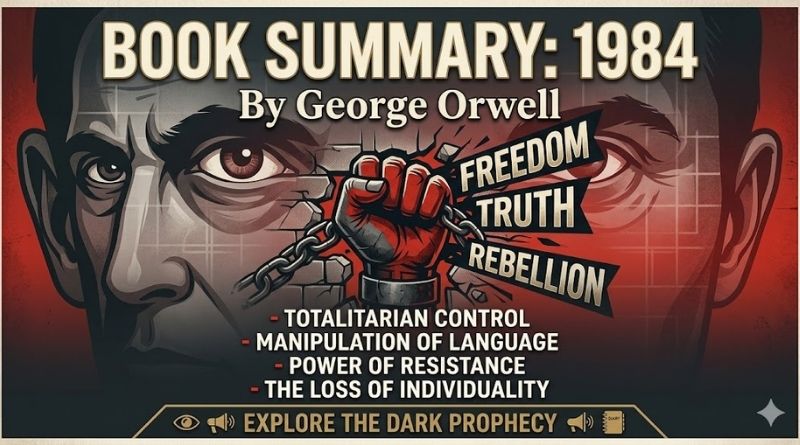
Key Themes Explored
1984 is packed with potent ideas that continue to shape how we understand power and society. Here are the core themes that struck me the most:
- Totalitarian Control: It’s not just about rules; it’s about a state that seeks to dominate your every action, word, and belief through constant surveillance via “telescreens.”
- The Manipulation of Language (Newspeak): Orwell famously argued that if you can control language, you can control thought. The official language, Newspeak, is designed to reduce the vocabulary of consciousness, making rebellion literally unthinkable.
- The Malleability of History and Truth: In Oceania, reality is whatever the Party says it is. If the Party says “two plus two equals five,” then it must be so. They constantly rewrite the past to align with the current political narrative.
- The Erasure of Individuality: The Party crushes personal identity, relationships, and even love, replacing them with a single-minded devotion to Big Brother.
Section Highlights: Winston’s Journey of Rebellion and Ruin
Book 1 Summary: 1984 — The Rebel Stirs
In the opening of the novel, we meet Winston Smith, a man already filled with a secret hatred for the Party. He lives in a gray, dilapidated London, where posters of Big Brother stare from every wall. He works at the Ministry of Truth (Minitrue)—ironically, the department responsible for rewriting historical records to ensure they always match the Party’s latest propaganda.
Winston commits his first act of rebellion by buying a blank diary from a proletarian (the “proles” are the working class, whom the Party mostly ignores but Winston sees as the only hope for revolution). In this diary, he writes, over and over, “DOWN WITH BIG BROTHER.” This is thoughtcrime, a capital offense. This act begins his quiet resistance, as he tries to hold onto his memory and his own perception of reality against the Party’s lies. It’s a tense and compelling start that sets up the high stakes of his defiance.
Book 2 Summary: 1984 — Love as Rebellion
The story truly ignites in the second part. Winston crosses paths with Julia, a fellow Party member whom he initially fears and suspects is a Thought Police agent. However, she passes him a note that says “I love you,” and they begin a secret, illegal affair. Their love is a profound act of political resistance, a celebration of human connection and desire in a world designed to eliminate both. They find a temporary haven in a rented room in the prole district, a place where they can briefly forget the telescreens and experience a fragile sense of freedom.
This 1984 book summary highlights that it is also in this section that Winston and Julia make a dangerous connection. They are approached by O’Brien, a powerful Inner Party member who leads them to believe he is part of the legendary “Brotherhood”—a secret underground resistance movement. This connection gives them hope, but they know their days are numbered.
Book 3 Summary: 1984 — The Breaking of the Spirit
In the devastating final section, the inevitable happens. Winston and Julia are betrayed and arrested in their secret room. The “proprietor” of their room, Mr. Charrington, was a Thought Police agent all along. The real hammer blow, though, comes in the Ministry of Love (Miniluv), where Winston is taken for torture and interrogation. His interrogator is none other than O’Brien, who reveals he was never a rebel. Instead, he is a faithful Party official whose sole job is to destroy Winston’s sanity and will.
The torture is not designed to kill Winston, but to remake him. Over a agonizing process, O’Brien uses physical pain, psychological manipulation, and relentless logic to make Winston accept the Party’s version of reality. The final, horrifying step occurs in the dreaded “Room 101,” where prisoners are confronted with their worst fears. For Winston, this is rats. As they are about to released, he cracks and shouts, “Do it to Julia! Not me!” With this final betrayal of the person he loved, his spirit is totally broken. He has been fully indoctrinated, and the novel ends with the chilling sentence: “He loved Big Brother.”
Memorable Quotes
Here are two quotes that always stick with me and perfectly capture the dread and power of Orwell’s world:
- “War is Peace. Freedom is Slavery. Ignorance is Strength.” Why this hits: These are the three official slogans of the Party, and they are a masterful example of “doublethink”—the ability to hold two completely contradictory beliefs simultaneously. They perfectly illustrate how the Party uses language to distort reality.
- “If you want a picture of the future, imagine a boot stamping on a human face—forever.” Why this hits: This is O’Brien’s brutal summation of the Party’s ultimate goal. It completely strips away any pretense that the Party’s power is about ideology or creating a better world; it’s simply about the raw, eternal exercise of power.
Who Should Read This Book?
Honestly, this is a must-read for everyone. But more specifically, I would recommend it to:
- Fans of Dystopian Fiction: It’s the grandfather of the genre, influencing books like The Handmaid’s Tale and The Hunger Games.
- Anyone Concerned with Politics and Power: It’s an essential text for understanding totalitarianism, propaganda, and how freedoms can be slowly eroded.
- People Curious about Media and Information: Its exploration of “fake news” and historical revisionism feels incredibly contemporary.
Final Verdict
1984 is not an easy book to read—it’s dark, hopeless, and deeply unsettling. But it’s also one of the most important novels of the 20th century. Its key takeaways and life lessons about the need for vigilance, independent thought, and the defense of objective truth have never been more critical.
Recommendation: Absolutely, a firm must-read. Its biggest strength is its terrifyingly detailed and logical world-building. Orwell thought through every implication of a truly total state. Its one potential “limitation” is that the third section is genuinely traumatizing. But that’s by design; it’s a crucial part of the message. This isn’t just a book review; it’s a testament to a story that changes how you see the world.