Quick Snapshot
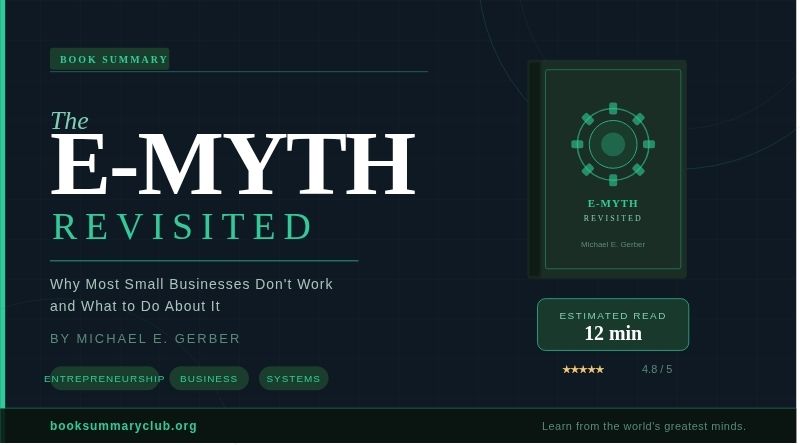
| Book Title | The E-Myth Revisited |
| Author | Michael E. Gerber |
| First Published | 1995 (revised edition) |
| Genre | Business / Entrepreneurship |
| Best For | Small business owners, aspiring entrepreneurs, startup founders |
| Core Message | Stop working IN your business. Start working ON it. |
| Our Rating | ★★★★★ — A must-read for every entrepreneur |
Why This Book Still Hits Hard After 30 Years
Have you ever met someone who was absolutely brilliant at their craft — a talented baker, a skilled mechanic, an expert designer — who decided to open their own business, only to burn out completely within a few years? If so, you have already witnessed what Michael E. Gerber calls the E-Myth in action.
The E-Myth Revisited, first published in 1995, is one of the most influential business books ever written. It has sold millions of copies worldwide and has been voted the number one business book by Inc. 500 CEOs. And the reason it keeps resonating with readers, decades after its release, is simple — it tells the truth about entrepreneurship in a way that nobody else was saying at the time.
The core truth? Being great at a skill does not automatically make you great at running a business built around that skill. In fact, it can be the very thing that destroys you.
| Key Insight | Most people start businesses because they are technically skilled — not because they understand how to build and run a business. This is the E-Myth, and it is the #1 reason small businesses fail. |
What Exactly Is the E-Myth?
The E-Myth — short for the Entrepreneurial Myth — is the false belief that people who start businesses are entrepreneurs. In reality, most people who start businesses are technicians who had what Gerber calls an Entrepreneurial Seizure.
Here is what that looks like in real life. You spend years working as an employee — maybe as a chef, a web developer, a hairdresser, or an accountant. You are really good at what you do. One day, you get frustrated — maybe your boss ignores your ideas, maybe you feel underpaid, maybe you just think, I can do this better on my own. And in that moment, you make the decision to start your own business.
The problem? You know how to do the technical work. But running a business is an entirely different skill set. And most people never realize this until they are already deep in trouble.
| The Fatal Assumption | The technician assumes that because they understand the technical work of a business, they also understand the business that does that technical work. But understanding carpentry and running a carpentry company are two completely different things. |
The Three Personalities Inside Every Business Owner
One of the most powerful frameworks in this book is Gerber’s idea that every business owner has three competing personalities living inside them. These three voices are constantly at war with each other, and whoever wins on any given day determines whether you move forward or stay stuck.
1. The Entrepreneur
The Entrepreneur is the dreamer — the visionary who imagines what could be. This personality sees opportunities everywhere, thinks about the big picture, and is always excited about the future. The Entrepreneur is the one who says, What if we could do this? or Imagine if we built that.
The problem with letting the Entrepreneur run the show all the time is that they live in the future. They get excited about new ideas but often struggle with the grind of execution. They want to build empires but hate dealing with today’s problems.
2. The Manager
The Manager is the opposite of the Entrepreneur. Where the Entrepreneur craves freedom and change, the Manager craves order and consistency. This personality wants systems, rules, processes, and predictability. The Manager is the one who says, We have always done it this way, and it works.
Too much Manager energy turns a business into a rigid, innovation-resistant machine. But without the Manager, nothing gets organized, nothing gets documented, and nothing runs reliably.
3. The Technician
The Technician is the doer — the one who loves the actual work. Whether that work is baking, coding, coaching, or designing, the Technician wants to get their hands dirty and produce something tangible. This personality is often the reason someone started the business in the first place.
The Technician’s fatal flaw? They believe that if they just work harder and do more, everything will be fine. They end up doing every job themselves, refusing to delegate, becoming the bottleneck of their own business. The Technician works IN the business instead of ON it.
| The Balance Problem | Most small business owners are 70% Technician, 20% Manager, and 10% Entrepreneur. For a business to truly succeed and scale, all three must be in balance — with the Entrepreneur leading the vision. |
The Three Stages of a Business Life
Gerber explains that every business goes through three predictable stages of growth. Understanding where you are in this cycle is crucial to surviving it.
Stage 1: Infancy
In infancy, the owner and the business are essentially the same thing. The owner does everything — sales, delivery, admin, customer service — all of it. This stage feels exciting at first because you are your own boss. But very quickly, it becomes exhausting.
The dangerous reality of infancy is that if the owner stops working, the business stops working. There is no separation between the person and the company. If you get sick, take a vacation, or simply burn out, everything falls apart.
Stage 2: Adolescence
At some point, the owner realizes they cannot do it all alone and starts hiring help. This is adolescence. It brings relief at first — finally, some breathing room. But it also brings new challenges: managing people, maintaining quality, and dealing with the chaos that comes with growth.
Most businesses get stuck here. The owner becomes a manager out of necessity but never truly lets go of the technical work. They micromanage because they do not trust others to do things the right way — their way.
Stage 3: Maturity
The mature business is what every entrepreneur dreams of but few actually build. A mature business is not dependent on any one person. It has systems, processes, and structures that allow it to run reliably — with or without the owner present every day.
Here is the key insight Gerber offers about maturity: truly mature businesses do not accidentally reach this stage. They are designed from day one with maturity in mind. The owner starts with the end in mind.
The Franchise Prototype — The Secret Weapon
This is where the book truly gets transformative. Gerber introduces the concept of the Franchise Prototype, and it completely changes the way you think about building a business.
Think about McDonald’s for a moment. Ray Kroc did not just build a hamburger restaurant — he built a system for running hamburger restaurants. Every single detail was documented, standardized, and designed to be replicated by anyone, anywhere, regardless of who was doing the work that day. The result? A business that works consistently whether Ray Kroc is there or not.
Gerber’s insight is that every business owner should think this way — even if they never plan to franchise. The question you should constantly ask yourself is: Could this business run successfully without me? If the answer is no, you do not have a business. You have a job — one that is more stressful and less secure than working for someone else.
| The Prototype Mindset | Build your business as if you are going to franchise it 5,000 times. Every process should be documented, every system should be repeatable, and every role should have a clear description. This is how you create a business that works even when you are not in it. |
Working ON Your Business vs. Working IN Your Business
This is the most famous concept from the book — and for good reason. It is deceptively simple, but most business owners never actually make the shift.
Working IN your business means doing the day-to-day tasks yourself — serving customers, writing the code, baking the bread, answering the emails. You are an employee of your own company, just without the benefits.
Working ON your business means stepping back and thinking like an architect. You are designing the systems, creating the processes, building the infrastructure that allows others to do the work well. You are focused on the bigger picture — strategy, growth, culture, and long-term sustainability.
The tragic irony Gerber points out is that the harder a Technician works in their business, the less likely the business is to grow. You become the ceiling of your own success. The only way to break through is to stop doing and start building.
Innovation, Quantification, and Orchestration
Gerber introduces a powerful three-step loop that successful businesses use to continuously improve. It is worth understanding each piece clearly.
Innovation
Innovation does not mean invention. It does not mean creating something brand new from scratch. In Gerber’s framework, innovation means asking: Is there a better way to do this? It is the relentless habit of questioning every process and looking for small improvements that compound over time. Even asking customers how they are greeted at the door — and finding a warmer, more memorable way to do it — is innovation.
Quantification
You cannot improve what you do not measure. Once you try something new, you need to track the results. Does it increase sales? Does it reduce errors? Does it make customers happier? Numbers tell you whether your innovation actually worked or just felt like it worked. Most small business owners operate on gut feelings. Successful business owners operate on data.
Orchestration
Once you find something that works, you do not leave it to chance. You build it into your system. You document it, train your team on it, and make it the standard way of doing things. Orchestration removes the randomness from your business and ensures every customer gets a consistently excellent experience — not just when you happen to be in a good mood that day.
5 Key Lessons From The E-Myth Revisited
1. Your business is not your life. Many business owners sacrifice everything — their health, their relationships, their happiness — for their business. Gerber’s message is clear: your business should serve your life, not the other way around. Define what you want your life to look like first, then build a business that makes that life possible.
2. Systems run businesses. People run systems. The biggest mistake small business owners make is believing that great people are the answer. In reality, even great people will fail without great systems. Build systems first. Then hire good people to run those systems. This is how McDonald’s produces consistent results with a different crew in every city.
3. You are not just building a product — you are building a business. A baker who opens a bakery is not just selling bread. They are building a business. Those are completely different activities. The bread is the product. The business is the machine that produces, markets, sells, and delivers that bread reliably every single day.
4. Delegation without systems is abdication. Many business owners try to delegate and fail — not because their employees are bad, but because there are no clear systems, processes, or standards in place. Before you can delegate effectively, you need to document exactly how things should be done.
5. Start with the end in mind. The most successful businesses are built backward. Before you write your first business plan, ask yourself: What does my ideal business look like in five or ten years? How does it operate? What does my role look like? Then design your current actions to create that future.
Who Should Read This Book?
The E-Myth Revisited is essential reading for anyone who owns or is thinking about owning a small business. But it is also deeply valuable for anyone in a leadership role, anyone building a startup, or anyone who feels trapped doing all the work themselves without seeing the growth they expected.
If you have ever said I do not have time to work on strategy because I am too busy doing everything else, this book was written specifically for you. That feeling of being trapped in your own business — constantly busy but never truly making progress — is exactly the symptom Gerber diagnoses and provides a cure for.
Even if you are not a business owner, this book will change the way you think about systems, processes, and the difference between being productive and being busy.
Final Verdict — Is It Worth Reading?
Absolutely, yes. The E-Myth Revisited is one of those rare books that makes you stop, put it down, and stare at the ceiling for a few minutes because something just clicked. It is not a feel-good, motivational book. It is an honest, sometimes uncomfortable look at why most small business owners end up more stressed and less free than they were as employees.
Michael Gerber delivers this message not through dry theory but through the story of Sarah, a pie baker who finds herself drowning in her own business. Following her journey makes the ideas deeply relatable and memorable in a way that a typical business textbook never could.
After reading this book, you will not look at a McDonald’s the same way again. You will see it for what it really is — not a fast food chain, but one of the greatest business systems ever built. And that is exactly the mindset Gerber wants you to carry into your own business.
| Bottom Line | The E-Myth Revisited will change how you think about business, systems, and your role as an owner. If you only read one business book this year, make it this one. |
Want more summaries like this?
Visit BookSummaryClub.org for weekly summaries of the world’s best business, self-improvement, and entrepreneurship books.