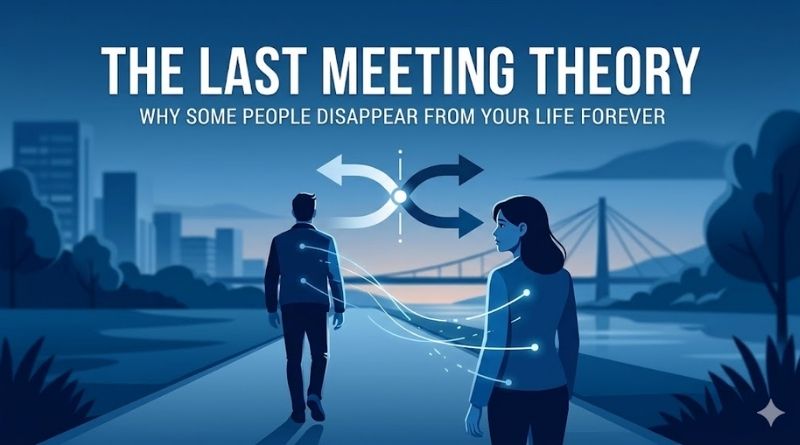
Think about someone you were once incredibly close to. A childhood best friend. A college roommate. An ex you swore you’d at least stay friends with. Someone who, at one point, felt like a permanent fixture in your life.
Now ask yourself — when was the last time you actually saw them?
For most of us, there’s no dramatic answer. No big fight. No tearful farewell. They just… stopped appearing. And the strangest part? Even if you both still live in the same city, walk the same streets, maybe even share mutual friends — you never cross paths. It’s as if the universe quietly closed a door between you, without anyone turning the key.
That’s what the Last Meeting Theory is all about.
What Is the Last Meeting Theory?
The Last Meeting Theory is a concept — part philosophical, part spiritual, part psychological — that suggests every relationship in your life has a natural expiration point. According to this idea, once two people have fulfilled the purpose they were meant to serve in each other’s lives, something shifts. The universe, fate, or simply the natural flow of life, ensures that their paths no longer intersect.
“Once you and someone you were connected to have completed the lessons you needed from each other, the universe ensures that you will never meet again.”
That’s a heavy thing to sit with. Because it means somewhere in your past, there was a final moment — a last coffee, a last phone call, a last wave goodbye — that you had no idea was actually the last one.
You weren’t prepared for it. Neither were they. And yet, it happened. And somehow, the two of you never found your way back to each other.
Why Does This Theory Feel So Real?
The reason this concept resonates so deeply with so many people is simple: almost everyone has experienced it. You don’t need a spiritual belief system to recognize the pattern.
Think about it honestly. Your school friends, the ones you swore you’d keep forever. Your first best friend from the neighborhood. The coworker who understood you better than anyone in the office. The person you traveled with and promised to visit again. Where are they now?
For most of us, they’re gone. Not because of hatred. Not because of betrayal. Just… gone. Life moved, and they moved in a different direction.
The Last Meeting Theory isn’t just a spiritual idea — it maps onto a deeply human experience. We all have people in our past who were once so central to our lives, and are now complete strangers. The theory gives language to something we’ve all felt but never quite knew how to explain.
What makes it even more surreal is the invisibility of those people afterward. You live in the same city. You might even drive past their house. But somehow, the chance encounters stop. The accidental run-ins that felt so common before — they just don’t happen anymore.
The Psychology Behind It: What Science Actually Says
Before we go fully into the spiritual side of things, let’s be honest about the psychology at play here — because it’s genuinely fascinating.
Your brain rewrites the map
When you emotionally let go of someone, your brain adjusts. The mental “map” you had of that person — where they go, what places you associate with them, what triggers a thought of them — gets quietly reorganized. You stop subconsciously scanning for them. You stop noticing the cues that would have previously reminded you of them. And so, in a very real neurological sense, they do disappear from your world — not because they moved, but because your brain stopped tracking them.
Emotional closure changes perception
Psychologists talk about something called perceptual narrowing — the idea that once we emotionally process something as finished, we genuinely stop noticing evidence of it. When a relationship reaches its natural end point, even unconsciously, your attention moves on. You stop seeing what you’re no longer looking for.
Life phases naturally separate people
Sociologists have long documented that human relationships are largely shaped by proximity and shared context — school, work, neighborhood, a specific season of life. When those contexts change, the relationships often don’t survive the transition. It’s not a failure. It’s just the nature of how human connection works. Most of our relationships are situational, even the ones that feel profound in the moment.
The Spiritual Interpretation: People Come With Purpose
Now for the part that moves people even more than the science — the idea that none of this is random.
The spiritual version of the Last Meeting Theory suggests that every person who enters your life arrives with a reason. They’re there to teach you something, to help you grow through a specific season, to mirror something back at you that you needed to see. And once that work is done — once the lesson is learned or the healing is complete — they exit. Not out of cruelty. Not even out of choice, necessarily. But because their purpose was fulfilled.
Think about the friend who showed up during the hardest year of your life. The one who sat with you through the grief or the breakup or the failure. Who helped you find your footing again. And then, slowly, drifted away — not because anything went wrong, but because the season changed.
The Last Meeting Theory says: that wasn’t an accident. That person was there precisely for that chapter. And when the chapter closed, so did their role in your story.
“It doesn’t make the connection any less real. If anything, it makes it more sacred — it served exactly the purpose it was meant to.”
The Kinds of People the Last Meeting Theory Covers
This theory isn’t just about romantic relationships or best friends. It applies across the full spectrum of human connection:
- The childhood friend who shaped how you see the world, then vanished after school ended
- The mentor or teacher who arrived at just the right moment and helped you find your direction
- The ex-partner who broke your heart but ultimately taught you what you actually needed from love
- The stranger on a flight or in a coffee shop who said exactly the right thing at exactly the right time
- The colleague who made an unbearable job survivable, then left — and somehow after that, you did too
- The friend who drifted — no fight, no reason, just a slow fading that neither of you tried to stop
What About the Connections That Don’t End?
Here’s the flip side — and it’s worth considering. Not every connection has a last meeting. Some people stay. Some friendships survive decades, distance, and life upheaval. Some loves root themselves so deeply that no amount of change dislodges them.
Maybe the Last Meeting Theory would say those connections have a different kind of purpose — an ongoing one. Not a lesson to learn and move on from, but a companionship meant to grow with you, evolving as you evolve.
And maybe the difference between the people who stay and the people who go isn’t about who loved harder or tried more. Maybe it’s simply about alignment — whether the two of you are growing in the same direction, or growing apart.
The people who stay aren’t always the ones you expected. And the ones who left weren’t always wrong to go. Sometimes the most meaningful thing a person can do for you is know when their chapter is over.
The Quiet Grief No One Talks About
There’s a particular kind of sadness that the Last Meeting Theory puts a name to. It’s not the dramatic grief of a death or a breakup. It’s quieter. More ambiguous. It’s the feeling of realizing that someone who once mattered enormously has simply… ceased to be part of your life, without ceremony.
No one held a funeral for that friendship. No one acknowledged the ending. You just woke up one day and noticed the absence — maybe years after it actually happened.
Psychologists sometimes call this ambiguous loss — grief for relationships that ended without clear resolution. It can be surprisingly heavy, precisely because there’s no event to point to, no wound to name. Just a quiet space where someone used to be.
Acknowledging that grief matters. Naming it — even privately — can be part of how you process it and move forward.
How to Find Peace With the People Who Are Gone
Whether you believe in the spiritual dimension of this theory or prefer the psychological explanation, the practical takeaway is the same: not all endings need to be failures.
Some connections close because they were complete. Not broken — complete. There’s a difference. And recognizing that difference can change the way you carry those memories.
Instead of replaying what went wrong, or wondering why they never reached back out, try asking a different question: What did that connection give me? What did you learn? How did you grow? Who did you become because of that person?
If the answers are real — if that connection genuinely shaped you — then it wasn’t a waste, no matter how it ended. It was, in the truest sense, a complete story.
“The universe has a way of clearing space when it’s time to grow. Sometimes losing someone isn’t the end of something good. It’s the beginning of something necessary.”
The One That Still Lingers
Here’s something the Last Meeting Theory doesn’t fully account for, though — and maybe it’s the most human part of all of this.
Some people leave, and you’re at peace with it. The chapter closed cleanly, even if quietly.
But then there are others. The ones you still think about in small, unexpected moments. When you hear a certain song. When you pass a place you once shared. When something happens that you know they would have understood in a way no one else quite does.
The theory says the purpose is complete. Maybe it is. But that doesn’t always make the absence easy to carry. And that’s okay too. You’re allowed to miss someone whose chapter is over. Closure and grief can coexist. Acceptance and longing can live in the same heart.
That’s not a contradiction. That’s just what it means to have loved someone — even briefly, even imperfectly, even in a chapter that’s now closed.
Final Thought: Every Meeting Carries Weight
Perhaps the most powerful thing about the Last Meeting Theory isn’t the idea of endings at all. It’s the invitation to be more present in your beginnings and middles.
Because you will never know, in the moment, which meeting is the last. You don’t get a warning. You don’t get a goodbye. You only get the moment itself — and the choice of how fully you show up in it.
So maybe the real lesson isn’t about why people disappear. Maybe it’s about how you choose to be present while they’re still here. How you love with intention, listen without distraction, and hold your connections — even the temporary ones — with a little more care.
Because one day, without announcement, it will be the last time. And the only thing that remains is what you made of all the times before it.
If this resonated with you, share it with someone who once meant the world to you — even if your chapter closed long ago.