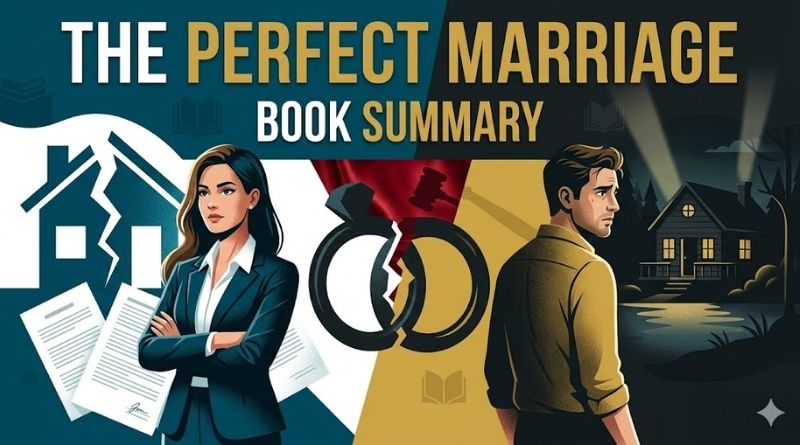
Would you defend your husband in court if he were accused of murdering the woman he was cheating on you with?
The Perfect Marriage Book Overview
In The Perfect Marriage, author Jeneva Rose crafts a domestic psychological thriller that grips you by the throat from the first chapter and doesn’t let go until the final, polarizing twist. The story centers on Sarah Morgan, a powerhouse Washington, D.C. defense attorney at the top of her game, and her husband, Adam, a struggling writer battling resentment over his wife’s success. Their facade of a flawless life is shattered when Adam is arrested for the brutal murder of his mistress, Kelly Summers, at the couple’s secluded lake cottage.
Key Themes
This domestic suspense novel isn’t just about “who done it”; it’s about the decay hiding beneath a polished surface. Here are the core key takeaways:
- The Deception of Appearance: The central premise is the shattering of the “perfect” facade. Every character projects an image that hides dark, contradictory realities, asking us how well we truly know anyone.
- The Duality of Betrayal: Betrayal here isn’t just the physical infidelity of Adam’s affair; it’s the systematic, long-term emotional and professional betrayal orchestrated by those seeking vengeance.
- Power and Control: The book explores how control is shifted and manipulated within relationships. Sarah holds the professional and financial power, while Adam attempts to regain control through his affair, unaware he is a pawn in a larger game.
- The Blurring of Justice and Revenge: The novel acts as a disturbing book review of the legal system, suggesting that “justice” can sometimes simply be meticulously planned, personalized revenge masquerading as the law.
Chapter Highlights: The Anatomy of a Collapse
Jeneva Rose structured this must-read thriller using alternating first-person points of view, shifting between Sarah and Adam. This style doesn’t just tell the story; it forces you to inhabit their conflicting realities. We don’t just read about their life lessons; we feel their panic, resentment, and deceit.
The Shattering
We start by meeting a couple defined by their imbalances. Sarah is brilliant, high-strung, and works around the clock. Adam is floundering, soft, and feels emasculated. When Adam is arrested, the novel doesn’t lean into his grief for his mistress; it dives into his terror of Sarah’s reaction. The genius of the early sections is Sarah’s decision to defend him. You’re constanty asking: Is she doing this out of twisted love, or is this a form of psychological torture?
The Trial
The middle section functions as a tight legal drama. Sarah is ruthless in the courtroom, systematically dismantling the prosecution’s case. Yet, her actions outside the courtroom are equally captivating. We see her managing her own emotions, manipulating her staff, and dealing with Adam’s overbearing mother, who blames Sarah’s career focus for driving Adam to cheat. The narrative tension is suffocating because you are aware that Sarah is defending the man who betrayed her, while simultaneously hunting his mistress’s killer.
The Revelation
I won’t spoil the major ending twist here, but I will say that it redefines everything you’ve read before it. The final chapters skip forward in time to Adam’s execution day. It is here that the alternating narratives finally collapse into a single, terrifying truth. The author pulls the rug out from under the reader, revealing that the “perfect marriage” was never about two people, but rather a meticulous, decade-long act of retribution. You are left questioning who the true villain of the story is, and whether “perfect” was always synonymous with “deadly.”
Memorable Quotes
Here are a couple of powerful quotes from The Perfect Marriage that encapsulate its dark heart:
“Even when you have nothing left in your life, hope is the one thing that can never be taken away.”
Why it hits: This is Sarah Morgan’s philosophy. It sounds inspiring, but in context, it’s chilling. It shows that her resilience isn’t born from innocence or love, but from a terrifying patience. She is willing to lose everything temporarily—her husband’s loyalty, her privacy—to ensure her ultimate victory.
“I know for a fact it wasn’t you.”
Why it hits: These six words, spoken by Sarah to Adam on his death row, are perhaps the most devastating line in the book. It’s the ultimate confirmation of her manipulation. It doesn’t offer him comfort; it reveals that he was framed by the only person he trusted to save him, ensuring his final moments are filled with horrified understanding.
Who Should Read This
You will love The Perfect Marriage if:
- You devour must-read psychological thrillers like Gone Girl or The Girl on the Train.
- You are fascinated by complex, unreliable narrators.
- You enjoy legal dramas that are more about psychological maneuvering than strict legal procedures.
- You are looking for a fast-paced self-improvement through cautionary tales rather than advice.
Final Verdict
The Perfect Marriage is an addictive, dark, and utterly compelling domestic thriller. I’ve read my fair share of twists, but Jeneva Rose managed to genuinely shock me. This isn’t a book you read; it’s a book you inhale.
Biggest Strength: The tension. The alternating perspectives are masterfully handled, keeping you suspended between Sarah’s calculating brilliance and Adam’s pathetic desperation.
One Limitation: The final twist is polarizing. For some readers, it makes the entire journey feel like a lie; for others (like me), it’s a brilliant realization that the author was playing a different game than the one we thought we were watching. Furthermore, some of the legal and forensic timelines feel compressed for narrative speed.
Ultimately, I highly recommend it if you enjoy thrillers that challenge your morality and leave you breathless.