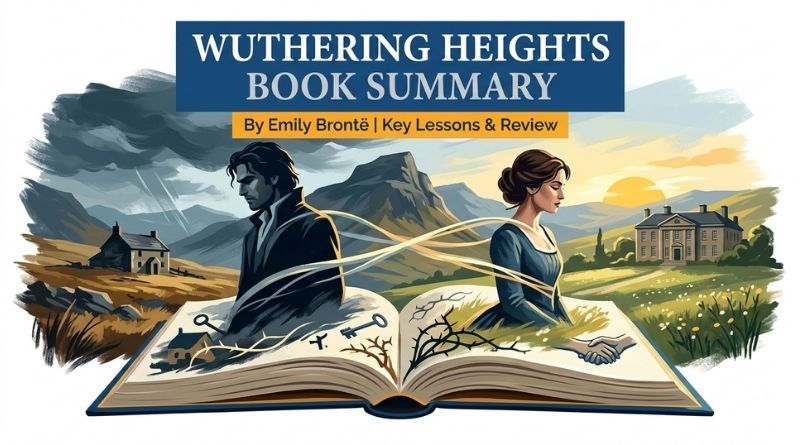
If you’ve ever wondered how love can transform from a beautiful connection into a haunting, generational curse, look no further than the wind-swept hills of the Yorkshire moors.
The Wild Heart of Emily Brontë’s Masterpiece
Wuthering Heights, the only novel written by Emily Brontë, is a titan of English literature that refuses to be put into a neat box. Published in 1847 under the pseudonym Ellis Bell, it isn’t your typical Victorian romance; it’s a dark, visceral exploration of obsession and the cyclical nature of violence. It matters because it shattered the era’s conventions, offering us characters who are unapologetically “difficult” and a setting that feels as alive and dangerous as the people inhabiting it.
Key Themes: Why This Story Still Stings
This must-read classic isn’t just about people being mean to each other in the rain. It digs into deep, uncomfortable truths about the human soul:
- The Destructive Power of Obsession: Heathcliff and Catherine don’t just love each other; they haunt each other. Their bond is so intense it leaves no room for peace or logic.
- Revenge as a Legacy: We see how one man’s bitterness can poison an entire family tree, proving that hurt people really do hurt people.
- Nature vs. Civilization: The wild, chaotic moors (represented by Wuthering Heights) are constantly at odds with the refined, stifling culture of Thrushcross Grange.
- Social Class and Outsider Status: Heathcliff’s journey from a “homeless” waif to a wealthy master is driven by the sting of being treated as “less than” because of his origins.
Walking Through the Storm: A Wuthering Heights Book Summary
To really get a book summary of wuthering heights, you have to understand its nested structure. We start with Mr. Lockwood, a somewhat vain city dweller who rents a house in the country and finds himself snowed in at Wuthering Heights. His encounter with the grumpy, middle-aged Heathcliff and a terrifying “ghost” at the window sets the stage. But the real meat of the story comes from Nelly Dean, the housekeeper who narrates the history of these families to Lockwood (and us).
The Earnshaw Era: Where the Fire Started
It all begins when Mr. Earnshaw brings home a “dark-skinned” orphan named Heathcliff. While young Catherine Earnshaw forms an instant, soul-deep bond with him, her brother Hindley views him as an interloper. This childhood rivalry is the catalyst for everything. When the father dies, Hindley takes over and degrades Heathcliff to the status of a farm laborer.
The turning point? Catherine spends a few weeks at the refined Thrushcross Grange. She returns “civilized,” wearing silk and looking down at a mud-caked Heathcliff. In a moment that changes their lives forever, Catherine confesses to Nelly that she loves Heathcliff, but it would “degrade” her to marry him. Heathcliff overhears only the insult and vanishes into the night.
The Return and the Long Game
Years later, Heathcliff returns—wealthy, polished, and absolutely lethal. He finds Catherine married to Edgar Linton, the polished owner of the Grange. This is where this book summary wuthering heights gets dark. Heathcliff isn’t back to win her over; he’s back to burn down everything Edgar and Hindley care about.
He marries Edgar’s sister, Isabella, just to spite him. He wins Wuthering Heights from Hindley in a gambling debt. He creates a living hell for everyone involved. Then, in the novel’s most famous and heartbreaking scene, Catherine dies giving birth to a daughter (also named Cathy), leaving Heathcliff to beg her ghost to haunt him until he dies. He cannot exist in a world where she isn’t there, even if her presence is a torment.
The Second Generation: Breaking the Cycle
The second half of the book often gets overlooked in shorter reviews, but it’s where the life lessons truly emerge. Heathcliff spends years manipulating the next generation—Catherine’s daughter, Hindley’s son (Hareton), and his own sickly son (Linton). He wants to own both estates and see his enemies’ children suffer.
However, a strange thing happens. Young Cathy and Hareton, despite being trapped in Heathcliff’s house of horrors, begin to fall in love. Hareton, who was kept illiterate by Heathcliff, starts to learn to read. Their growth represents a shift from obsession to a healthy, redemptive affection. Seeing this, Heathcliff loses his will to fight. He realizes that his revenge has become hollow. He stops eating, starts seeing “visions” of the elder Catherine, and eventually dies, finally finding the union in death that escaped him in life.
Memorable Quotes That Hit Home
“I am Heathcliff! He’s always, always in my mind: not as a pleasure, any more than I am always a pleasure to myself, but as my own being.”
This is perhaps the most famous line in the book. It perfectly captures that “meta-love” Catherine feels. It’s not about liking someone; it’s about recognizing them as a mirror of your own soul.
“I have not broken your heart—you have broken it; and in breaking it, you have broken mine.”
Heathcliff says this to a dying Catherine. It’s raw and accusatory, showing that in their world, love was a form of mutual destruction.
Who Should Read This?
If you’re a fan of Gothic literature or psychological dramas, this is your holy grail. It’s perfect for readers who:
- Are tired of “fluff” romances and want something with teeth.
- Enjoy atmospheric settings where the weather reflects the characters’ moods.
- Want to study complex, “anti-hero” character arcs.
- Are looking for a classic that feels surprisingly modern in its grit.
Final Verdict: Is It Worth the Hype?
In my book review, I’d say Wuthering Heights is a 5-star experience, but with a warning: don’t expect to “like” the characters. You wouldn’t want to have dinner with Heathcliff or Catherine, but you won’t be able to look away from them either.
The Biggest Strength: The atmosphere. Brontë creates a sense of place so thick you can almost smell the wet heather and feel the wind biting at your face. It is a masterclass in mood.
The Limitation: The “nested” narration (Lockwood telling us what Nelly told him) can be a bit clunky at first. It takes a few chapters to get your bearings, but once Nelly starts the history, the pace picks up significantly.
Ultimately, this story leaves you feeling haunted. It’s a reminder that while passion can be a creative force, when mixed with pride and revenge, it becomes a wildfire that spares no one. If you want a story that stays with you long after the final page, this is it.